A Special Unhappiness
Rereading Kate Chopin's 1899 novel The Awakening

The Pontellier family is unhappy. More precisely, Mrs. Pontellier— Edna—is unhappy, and she does not care if that makes others unhappy too.
When I first read Kate Chopin’s novel The Awakening decades ago I was not troubled by the protagonist’s indifference toward others. I was charmed by the novel’s exotic setting—it opens with a parrot squawking obscure warnings in French and Italian on a remote spit of land in the Gulf of Mexico—and appreciated the author’s sensitive portrayal of scene and psyche. I also saw little reason to question the book’s fundamental assertion about 19th-century America’s repression of women and its intolerance for those who would be liberated.
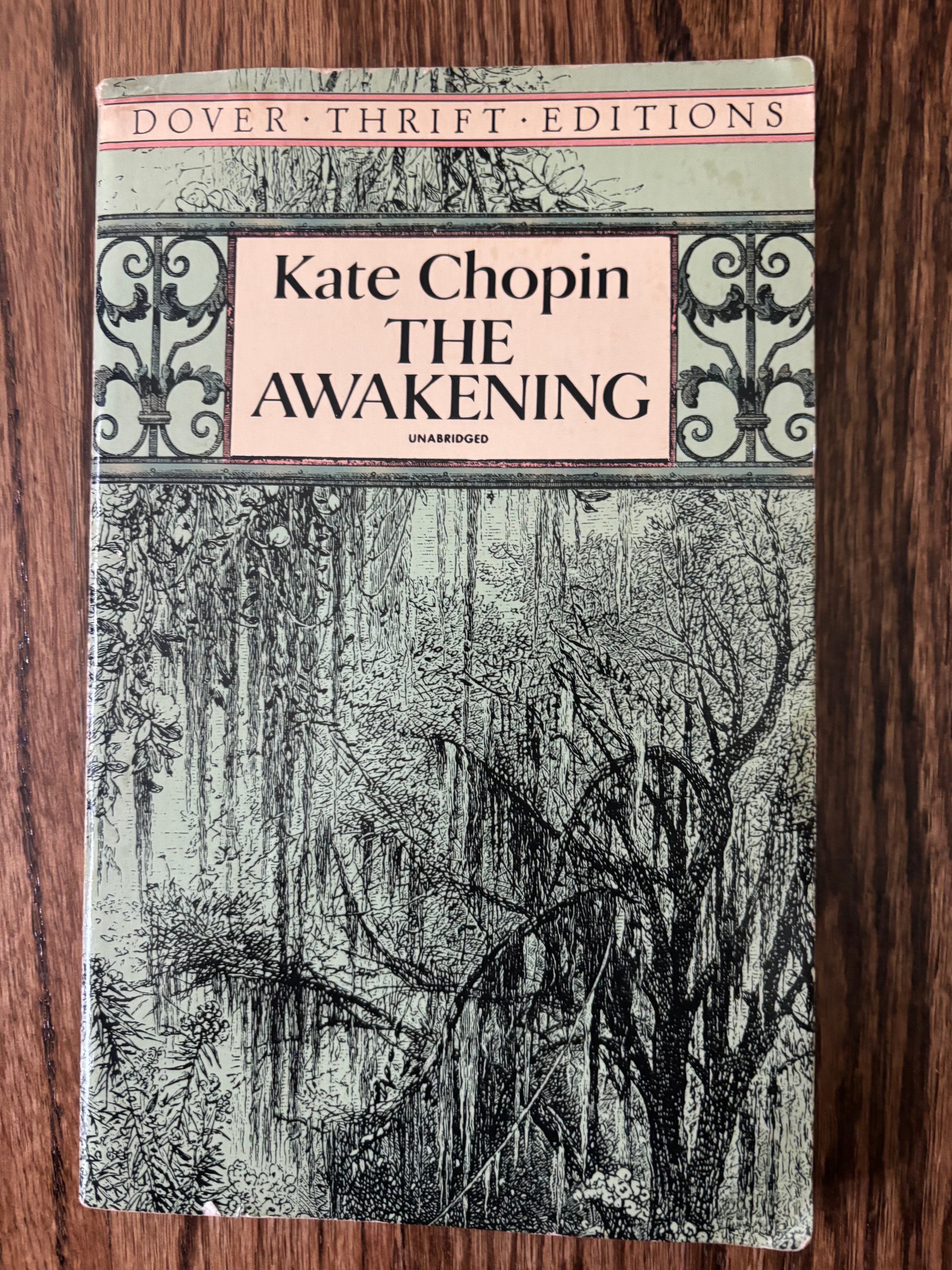
Forty years later, I still appreciate Chopin’s skill and the book’s beguiling atmospherics. But this time around—with some experience of life behind me—I find Edna’s solipsism so disturbing that it effectively eclipses any sympathy I have for the book and its early-feminist advocacy.
The story takes place in the 1890s, in and around New Orleans. Edna is a Kentucky-bred Protestant placed by marriage in the affluent, southern Louisiana Creole society, which is Catholic, French in origin and style, and marked by free-wheeling manners and intimacies that demand her continual monitoring and interpretation.
Edna has two young sons, Etienne and Raoul, to whom she is sympathetic but largely indifferent, and an attentive husband named Leonce, whose interest in the stock market affords the family a comfortable city home filled with thick rugs and cut crystal, extended vacations at the beach, and wherever they go, servants.
Yes, Leonce can be a jerk. In an early, intimate nighttime scene on Grande Isle, the resort where the family summers and that Leonce visits when he is not working or at the club, he loses his patience with Edna for lingering outside in a hammock long after everyone else is asleep. “‘This is more than folly,’” he tells her. “‘I can’t permit you to stay out there all night. You must come in the house instantly.’” But he also writes her thoughtful letters when he travels, sends gifts, and worries about his children. All things considered, he seems a not terrible example of a man of his era.
The Awakening is about how Edna comes to find him unbearable and abandons everything she has in her quest for self-expression and passion.
Poor baby! One wishes that, along the way, she paid even one moment’s attention to the servants—”the mulatto”, “the quadroon”, “the black woman” and “the Griffe”—who toil, unnamed and unvoiced, on her behalf. Even the young lover for whom she would sacrifice all, Robert, gets no consideration. She cannot understand why he chooses to avoid her rather than invite scandal and heartbreak by professing love to a married mother of two. Here is part of that exchange:
“Why have you kept away from me, Robert?” She asked, closing the book that lay open upon the table.
“Why are you so personal, Mrs. Pontellier? Why do you force me to idiotic subterfuges?” He exclaimed with sudden warmth. “I suppose there’s no use telling you I’ve been very busy, or that I’ve been sick, or that I’ve been to see you and not found you at home. Please let me off with any one of these excuses.”
“‘You are the embodiment of selfishness,” she said. “You save yourself something—I don’t know what—but there is some selfish motive, and in sparing yourself you never consider for a moment what I think, or how I feel your neglect and indifference.”
The great Willa Cather—who someday I hope to revisit in this series—nicely sums up Edna’s type, which she pairs with Gustave Flaubert’s famous character Emma Bovary: “Both women belong to a class, not large, but forever clamoring in our ears, that demands more romance out of life than God put into it.”1
Funnily enough, Edna Pontillier is exactly the sort of woman John Maynard Keynes had in mind when he wrote The Economic Possibilities for Our Grandchildren, which I have written about previously. Being deprived of the need to work, Edna throws her freshly liberated energy into sketching and drawing. This artist cosplay, however, only feeds her poisonous solipsism.
Imagine for a moment if this woman had devoted even a fraction of her time and energy into supporting those less fortunate than she. I wonder, could Edna Pontillier have found that a satisfying way to live?
Perhaps not, given the glimpse Chopin offers into her heroine’s early life. Motherless from a tender age, Edna was raised by a stern Presbyterian father who she recalls “...reading prayers in a spirit of gloom…that chills me yet to think of.” It comes as no surprise, then, when Chopin later tells us, “She [Edna] was not accustomed to an outward and spoken expression of affection, either in herself or of others.”
In short, Edna is a spoiled, selfish woman with a wounded soul. There are cures for that sort of thing. Edna thinks eloping with Robert is one of them.
One can readily imagine the hot mess that would have transpired had he consented.
Rereading The Awakening prompted me to reflect on why I so enjoyed the book the first time around, and what that might reveal about me. My peers in those days may have aspired to get rich, become famous, or find a cure for cancer. In my late teens and early 20s, I wanted to learn more about the world—I was eager to see it, to witness it, to explore it. This, likely, is what warmed me to this exotically placed piece of fiction…and what blinded me to its troubles.
Willa Cather’s review from The Pittsburg Leader, July 8, 1899: https://amerlit.com/documents/REVIEW%20of%20the%20Awakening%20by%20Willa%20Cather.pdf
That Willa Cather quote…💯!