On On Violence
Re-reading a lamentably timely text by Hannah Arendt

Recent events in the US and abroad compelled me to revisit Hannah Arendt’s 1969 essay On Violence.
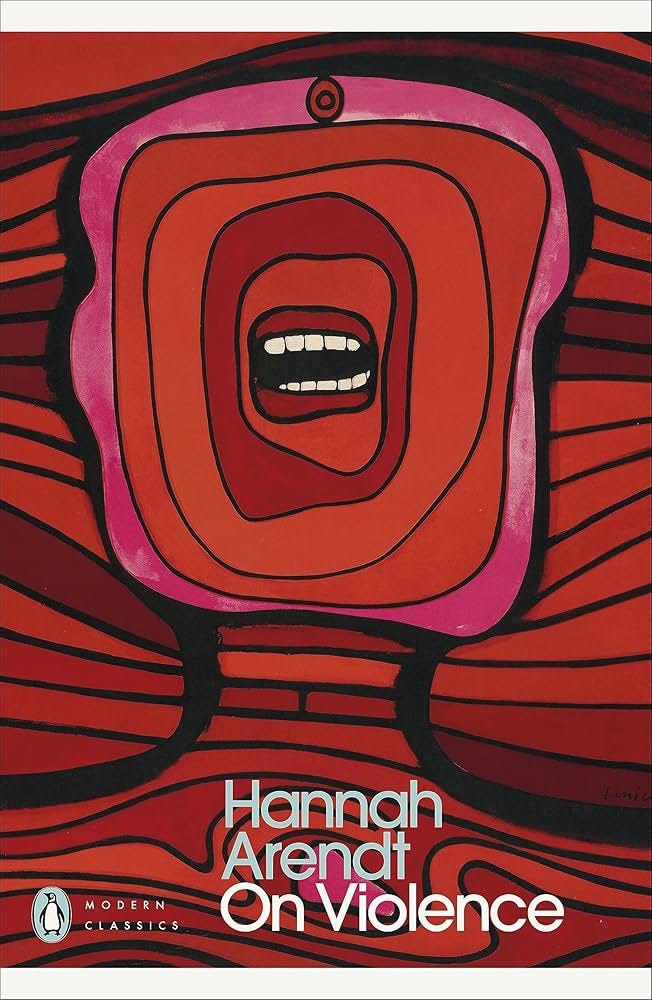
When I first read this book, in the 2000s, I felt as a medieval monk might have after stumbling upon a manuscript from ancient Greece or Rome. Arendt offered a bracing analysis, but I had little connection to the circumstances that provoked it. The Vietnam War, student protests, and the assassinations of Martin Luther King, Jr. and Robert F. Kennedy (not to mention the abominations of the Third Reich, from which Arendt was a refugee) all seemed like relics of a settled, bygone era.
This time around Arendt’s book seems an essential guide for the present.
Arendt approaches the concept of violence from a variety of perspectives, like a sommelier sniffing, tasting, and scrutinizing an unfamiliar vintage. Early on, for example, she asserts that warfare is no longer a viable form of violence (except among countries lacking the capacity for total nuclear destruction). Later, there is a passage about the biology of violence, which she briskly dismisses as irrelevant, and some brief but intriguing speculation about the waxing influence of technology.
Most of the text, however, focuses on violence in the political context. This inquiry begins with a helpful glossary of words often conflated with violence. Power, for example, Arendt defines as “the human ability not just to act, but to act in concert”. Strength is a “property inherent in an object or person”. Force, “the energy released by physical or social movements”. Legitimacy is what validates power: “Power springs up whenever people get together and act in concert,” she writes, “...but it derives its legitimacy from the initial getting together….”
Among all these terms, “violence” stands out as a tool rather than a quality. The ability to deploy this tool would seem an expression of power. But in the political context, Arendt contends, violence is deployed precisely where power ends:
“Violence appears as a last resort to keep the power structure intact against individual challengers – the foreign enemy, the native criminal….”
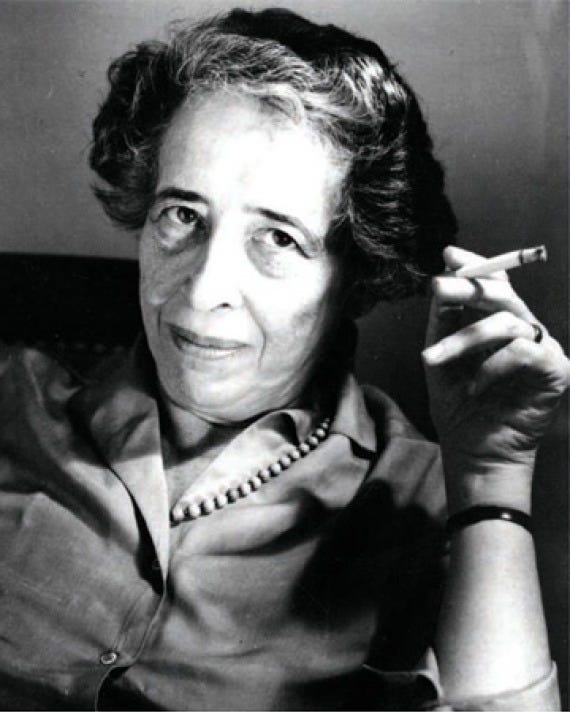
The truer measure of power, Arendt says, is public support.
“It is the people’s support that lends power to the institutions of a country, and this support is but the continuation of the consent that brought the laws into existence to begin with. Under conditions of representative government, the people are supposed to rule those who govern them.”
If this premise is correct—and I think it is—a government resorting to violence against its own people shows both weakness and potential illegitimacy. A weak and possibly illegitimate government can still be dangerous, though. As Arendt notes, had the British been even more comfortable inflicting casualties upon the Indian citizenry, Gandhi’s liberation movement may not have succeeded.
As recent reports and images seeping out of Iran suggest, it is a gamble to trust in a limit to how violent your weakened government might become. Nevertheless, I draw two useful conclusions from this book. The first is that those who would resist government-sponsored violence would be wise to build their power (by expanding their numbers and strengthening their bonds—including internationally) while they also work to diminish support for the other side. As Arendt explains,
“...[I]n a contest of violence against violence, the superiority of the government has always been absolute; but this superiority lasts only as long as the power structure of the government is intact – that is, as long as commands are obeyed and the army or police forces are prepared to use their weapons. When this is no longer the case, the situation changes abruptly…. Where commands are no longer obeyed, the means of violence are of no use; and the question of this obedience is not decided by the command-obedience relation but by opinion, and, of course, by the number of those who share it.”
The second conclusion pertains to the angry comments—verbal violence—one often encounters online. Arendt’s analysis has helped me to stop experiencing these voices as surprising, startling, or intimidating. Instead, they now register as frightened. They remind me of lizards that inflate their necks or bodies when alarmed, or the projected face of the “great and powerful Oz”, which Dorothy effectively diminishes simply by parting the curtain where the actual man is concealed.
Our present times, certainly, are dismal. But re-reading Hannah Arendt has offered me some fresh perspective on them. In doing so, it has also provided some much-appreciated hope.
P.S. There is far more in Arendt’s short essay that I did not address here. One snippet that I particularly enjoyed, for example, is the idea that a faceless bureaucracy represents the worst kind of tyranny and generates the deepest sort of rage—an idea worth following up on.
For those who are curious, I cannot recommend this book enough.
The more things change, the more they stay the same...